 |
| http://www.youtube.com/watch?v=Jz8Y9lXyTNw |

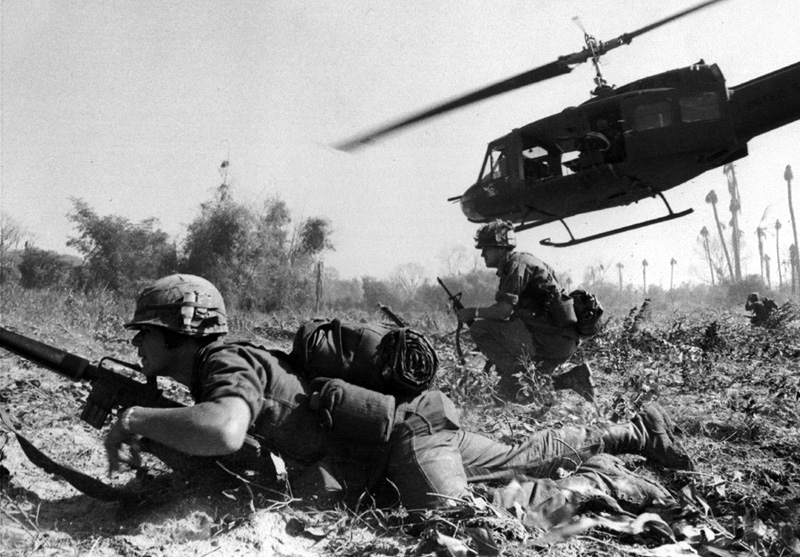
Vietnam deployment
The Vietnam war lasted for a good 20 years. It had a bunch of people involved but it was mainly a civil war between the Vietnamese, with added fuel to the fire by world superpowers... and others... I'm looking at you Best Korea. The war, like any other, had a huge casualty toll, mostly civilians. It all ended with the fall of Saigon in 1975.
What we have pictured is a US helicopter dropping off troops on a search and destroy mission (you also had other missions like: headquarters, capture the flag, team deathmatch - WOW THIS IS THE SECOND TIME I USE THIS JOKE I FEEL SO CREATIVE). The Vietnam war, unlike the previous major conflict, WW2, used a lot of helicopters. Now we just fly our radio control helicopters from the comfort of our sofa.

Effects of nuclear weapons
So it's 1945 you're chilling and then all of a sudden you get vaporized. This picture shows what happened after Enola Gay took a trip to Japan. A person was allegedly sitting there near ground zero and this is what was left of them after the blast. If you were 'lucky' to survive you'd spent the rest of your life living like a freak of nature thanks to nuclear weapons. We as humans did and continue doing a lot of bad things, but this one wins the prize.
Nuclear weapons not only offer immediate destruction but horrible
aftermaths.
Not only nuclear weapons pose a threat, but nuclear energy as well (see: Chernobyl, Fukushima). Despite the dangers of it, there are nuclear power plants being constructed across the world. Then again, some countries halted their nuclear energy programs and started investing more in renewable energy sources, like solar panels. Even though, we still consume a lot of energy and keep polluting our one and only rock.
 |
| No witty caption, this gives me the chills. |
Old mine workers
If you think that today we got it bad, take a look at this jolly bunch. During the first industrial period, people used to work way more hours and under tougher conditions. Then when that wasn't enough, capitalists got slaves to help out. Basically, what would happen is that you work your ass off and after a while you get cholera or syphilis from the local wench and die. My guess is that they didn't use work gloves.
Mining was the key industry back then. Upon closer inspection of this photo, you can see that it was a multiple generational business, meaning you had kids and very old people happily working together. They all had the right tools at disposal, well not really cordless power tools but you get the general idea, and the adequate life expectancy.
 |
| HE SEES INTO MY SOUL. |
Make love not war
The 60s were a great era, minus the Vietnam war and the hippies... and the Cuban missile crisis... and a bunch of other stuff. The Vietnam war was a turning point in the anti war movement. Basically there were a lot of cameras reporting directly from the battlefield. When people saw what was going on there they were appalled, so they went out and protested. Or they could have just sit tight and wait to be drafted themselves.
The army, beside offering cheap flights to Vietnam, lost a lot of men and nearing the end of the war, casualties, both civilian and military rose. As the anti war movement grew, pressure was on the US government to halt it's south-Asia activities and withdraw. The withdrawal was pretty nasty. Basically everybody had one day to check out from their Saigon hotels (see: Fall of Saigon). The results of the war teaches everyone a lesson: don't bring cameras make love not war.
 |
| Imagine a bayonet charge now. |
Friendly fire
The use of airplanes in WW2 went up. They were used for reconnaissance, bombardment, supply, dogfights and... based on this picture, friendly fire. Aviation played a key role in the war. First it was the Luftwaffe which utilized it for their Blitzkrieg tactics. After that, airplanes had a crucial role in the Battle of Britain where the UK and German air force collided.
Soon enough the Soviets, Americans, Japanese... everybody was racing to make the better fighter or bomber. There were crazy aircraft models being produced: jet fighters, plans for world-wide-bombers which could drop nukes on the other side of the globe, submarines with airplanes... In the end, the Allies prevailed in the skies since the Axis supplies were running thin and they couldn't keep up with the production and aviation financing.
 |
| BLUE ON BLUE. |
1906 San Francisco earthquake aftermath
The SF earthquake of 1906 is considered to be one of the worst natural disasters in the US. Almost 80% of SF was destroyed from the earthquake and fires. Oh and about those fires, well, it was a war zone... Bunch of people were insured in case a fire happens, but not many were
insured against an earthquake. So people, being in fear of insurance not
covering their earthquake damaged houses, did the next most logical thing - they set their houses on fire.
One fire was so great that they had to blow up chunks of buildings (literally stack TNT in a place) around a few city blocks so they would collapse and stop the fire from spreading. They even used artillery. Soon enough, the army moved in to help and they kinda stopped the looting and helped people. They even shot men who were trapped on rooftops and wanted to jump. All in all, a 10/10 tragedy.
 |
| If you're going to San Francisco... |
Stock market crash
I never fully understood the stock market. You have a bunch indicators, buying, selling, people yelling around, movies being made about it, people tripping... about it. But throughout it all there's a strange feeling related to it, something like gambling, even though it's a "science" and you need to know your shit.
 |
| That's what you get for |
Newark riots, 1967
The 60s in US brought a bunch of changes, mostly social ones. Also there was a bunch of hippies and experimental substances. One of the main hip and cool things to do back then was to fight for something called "human rights". All you had to do was to go out on the street and stick it to the man, then somehow, magically, tomorrow will be a better day for everybody.
One of these events were the Newark riots in July, 1967. Basically, the police of Newark was closely related to the KKK and would pull over brothers for no reasons at all, disrupting their busy schedule of malt liquor drinking. One day they pulled over the wrong motherfucker and riots broke out. Movie coming soon, starring Samuel L. Jackson and Shia LaBeouf.
 |
| I've stared at this picture for like 10 minutes and couldn't come up with a witty caption. Sorry. |
British special forces training
Jumping around on rocks, rappelling down cliffs... flying off them. It's just one of the many things they can do, all in the name of
 |
| https://www.youtube.com/watch?v=7IGPv2r_A1o |
Blimp over Turnaround - Seaside, Oregon
This place still exists today. It's neat to see how the turnaround stood up to the wear and tear of time and how people got more weight on. I assume this was taken in the 1940s judging by the cars, clothing and the image itself.
Then again, it could be some time before the Hindenburg since there's a blimp flying around... Who knows. Seaside, Oregon is a neat little place in Clatsop county with about 6.500 people. It was founded in the 1800s. The name comes from Seaside House which was an old summer resort built by Ben Holladay, a railroad monarch.
 |
| Is it a bird? Is it a plane? No it's a blimp. Calm down. |
Chuck Norris and Bruce Lee
The 70s were a great era. Great music, entertainment, hilarious outfits, even more hilarious hairstyles and beards. What really marked the 70s for me was music and cinema. You had all sorts of movies being made, but I really dig the action ones... and vintage uhh... ones. Such era paved the way for world wide known artists and actors that everybody heard of and knows of even today.
Take Chuck Norris for example. He really kicked off (more like roundhouse kicked off, amirite?) in the 70s with several movies before solidifying his place on the throne of cheesy action TV shows with "The Texas Ranger" or walker or something, I never watched a single episode of it, couldn't do it. Bruce Lee on the other hand, was a pretty badass dude. He fought for a living, who knows what else he did in Hong Kong and made only several film appearances but he carved his name straight into legend.
 |
| The third guy is trying to get away from all the badassery. |
WW2 combat
The second world war was an armed conflict that took place from 1939 up to 1945, involving many countries fighting on many battlefields. WW2 produced a number of badass photos, but this one wins the prize so far.
 |
| What ever happened to Lucky Legs I? |
University of California, 1940
Look at all these badasses. University of California, Berkeley is probably one of the most famous universities in the USA. It was formed in the distant 1868 with the merge of several colleges and today it offers a whole variety of possible fields of studying, but it is also one of the most selective public university in the US.
The educational impact UC Berkeley had was great. The university "produced" a lot of Nobel prize winners, nuclear researchers and in general a very high number of successful, educated people. So if you're interested in economy, business, administration, law or in chemistry, engineering, science and many more fields, check out a college or two in Berkeley.
 |
| And 70 years later, nothing changed. |
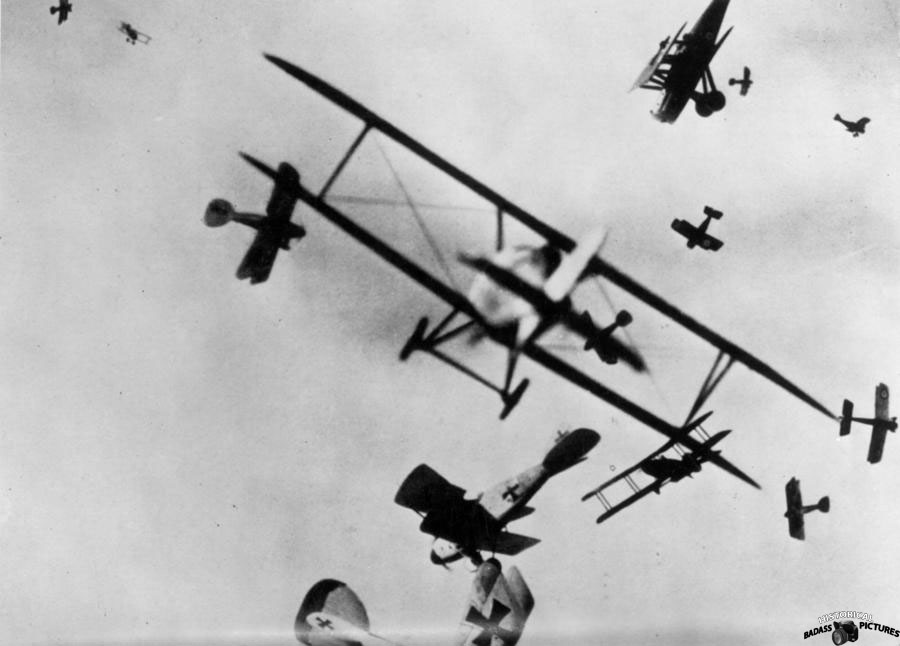
WW1 dogfight
To prove how us humans are always advancing and evolving through time, we have the perfect example. Airplanes. We all know of their early beginnings and how the initial planes were very fragile and unreliable, but I'd like to put more emphasis on the peoples capability to attach guns to them as soon as they were airborne.
 |
| Where did Hans go? |
WW2 flamethrower
Using fire, more specifically using flamethrowers became standardized in the 20th century, but it has his origins in ancient Greece (the so called Greek fire) and in China. Modern flamethrowers were introduced during WW1 in it's infamous trench warfare. They were also used in WW2 and later on.
Using a flamethrower was a great way to clear out trenches in WW1. In WW2, as we can see on the picture, a group of American soldiers is using it on what seems to be a bunker. The usage of flamethrowers was very important to clear out caves and underground networks / fortifications.
 |
| It werfs flammen. |
1950s supermarket
The 1950s, especially in the United States, was a very specific era, characterized by post war economical expansion and social reforms. It ushered an age of consumerism. People were buying cars, going out shopping and doing various different things that weren't considered your average routine before the war.
On this picture we have a Piggly Wiggly supermarket. It is one of the oldest supermarket chains (franchise) in the world. They were the first to do several major things, that are now considered normal in a grocery store, such as: put price marks on goods, introduce shopping carts, use refrigerators to keep goods fresh, uniform employees etc.
 |
| Where are the obese people? |
Victorian era safari hunter
The 19th century was marked as the Victorian era for Britain, which at the time, was at it's colonial powers peak and it's industrial growth and development were far ahead compared to the rest of the world. There is a a lot of memorable styling and characteristics of that era,
especially what people used to wear. You can also vividly imagine some
dark and grim London streets, horse chariots, prostitutes... Jack the
Ripper.
Britain was the dominant colonial power in Africa and all around the world basically, hence why the majority of people all around the world today know how to speak English. Colonialism had it's good and bad sides.
 |
| Today's schedule: shoot elephants, whip Africans, drink tea. |
Prohibition
When you say the word "prohibition" many people associate it with the roaring twenties of the USA, mobsters, smuggling, wild parties and cities like New York or Chicago. But prohibition has a history, dating to as early as ancient China. The modern day bans on alcohol showed up and lasted in the first few decades of the 20th century, as an attempt to help society get sober.
 |
| You're not supposed to spill it down the drain... |
Possibly the most known was the prohibition in the US which lasted during the 1920s and 30s. It basically prohibited making and distributing alcoholic beverages, in order to create a better society. It failed. The law was bypassed, bent, broken, you name it, just to get liquor distributed. This ushered the era of great crime lords like Al Capone and a network of criminal organizations which smuggled and distributed alcohol.
JFK campaigning
JFK was probably one of the most charismatic and famous presidents in history. He was very well known for his positive American image. During his presidency he made several key moves, but the most important one was his direct involvement to end the Cuban missile crisis. His presidential term ended tragically in Dallas, where he was assassinated. The Kennedy assassination is one of the most debated, controversial and conspiracy theory filled subjects.
But lets take a look at what's real here. Here he is just as just a simple man, standing on a makeshift stage speaking to the people. Kennedy's life suggests that he was a very persistent man, often going against his own good, for a higher goal.
 |
| Probably the closest someone with their gun drawn got in the vicinity a president. |
Combat veteran
Through various research it has been established that humans, at least the majority of us, are not capable to kill another human being as it's considered unnatural by the brain. Only a small percentage of the human population find killing another human normal. They are called psychopaths. Exposing your average Joe to such situations (e.g. war) will eventually lead to a number of mental health issues, such as PTSD.
It is possible to lower that "don't kill" factor by extensive training and making the use of weapons a common thing, which will lead to combat activities being just a muscle memory thing. But all the training won't do much after combat, when a person is alone and thinks of the things he's done.
 |
| Take over Russia he said. It'll be quick he said. |
Subscribe to:
Posts (Atom)